I don’t often know at the start of the year what project it is that’s going to feel like my main accomplishment of the year, by the end of the year. But I try to have at least one, every year. This is the story of my biggest accomplishment of 2026 and at the end of this post you can watch the 3 minute teaser trailer I created.
In April of 2026, I stumbled on an announcement that XPRIZE—the same organization that has paid out huge cash prizes to rocket science and carbon capture initiatives—was offering millions of dollars in prize money to people pitching optimistic science fiction films. It seemed like a no-brainer that I should take part.
I often think that the biggest barrier to creating a better future for all humans is convincing people that a better future for all humans is possible.
We actually have all the knowledge, resources and technology to do it. We’re just so thoroughly convinced that it’s not possible, that it has become a self-fulfilling prophecy. It’s certainly easier to imagine how things could get worse from here than to imagine how things could get better. Our brains are wired, by evolution, to seek out and prepare for the worst possible outcomes. Perhaps if there were more movies showing plausible good futures, rather than just plausible dystopian futures, it might move the needle in the right direction. That was exactly the pitch that XPRIZE was making and it dovetailed perfectly with what we’ve been trying to do at United Humans. The competition was open to all comers, regardless of background, filmmaking experience or budget. It was inspiring to think that this competition could see hundreds or even thousands of promising ideas about a hopeful, technology-enabled future elevated into the public discourse.
I also appreciated having an external deadline, which is often the best way to turn a seed of an idea into a project that actually gets done. And it’s not like I was starting from scratch. I’ve personally spent a significant portion of the past 18 years imagining what a better future for all humans might look like. And I’ve spent the better part of 27 years making movies.
But… I had already committed to spending three months backpacking around Europe this summer. And, incidentally, the deadline for the Future Vision XPRIZE competition was in the final week of our trip, when we were scheduled to be camping on a remote peninsular in Iceland, awaiting a total solar eclipse, at a music, science and woo-woo festival, surrounded by astronauts, astrologers, psychonauts and cynics.
Before we left on our trip (which eventually included a dozen countries) I set about thinking up a story that could take place in the future world that I have been imagining for all these years. A world of abundance where, instead of each of us taking whatever we can, given the circumstances we find ourselves in, we take only what we need and try to make sure everyone else also gets what they need, too. A world where, instead of each of us being required to be arbitrarily productive in order to survive, we let robots and algorithms handle all the menial work that can be easily automated and we humans split our time between doing the important things that can’t be automated and doing all the other stuff that actually makes life meaningful.
I knew I didn’t want it to be too on the nose or preachy. I wanted a practical, appealing utopia to be the wallpaper behind a compelling story. The story itself ought to be funny. And exciting. It needed to have believable, lovable characters leading rich, layered lives. It also needed to be rewatchable if it was to stand a chance of significantly influencing culture. When I put all that together, it became clear I was working on an optimistic action-adventure comedy sci-fi Christmas movie.
Over several weeks of brainstorming and iterating (mostly alone, but sometimes with THC and sometimes with a GPT or LLM to bounce ideas off of), I fleshed out the world that the story would take place in. As I built out the world, characters started to emerge. And as I got to know the characters, their stories began to take shape in my mind.
I realized that one thing most sci-fi movies get wrong is that they depict a world that was all built in the same era. But we’re living in yesterday’s future and we know that (with the exception of massive natural disasters and wars) real cities get built and rebuilt piecemeal. A realistic future version of Vancouver would still have many of the same buildings as today. Maybe they’d be upgraded with sustainable energy infrastructure and green roofs and certainly there would be new buildings amongst the old. But it would still be recognizable as Vancouver.
This image shows the version of Vancouver that I came up with, visualized courtesy of AI image generation.
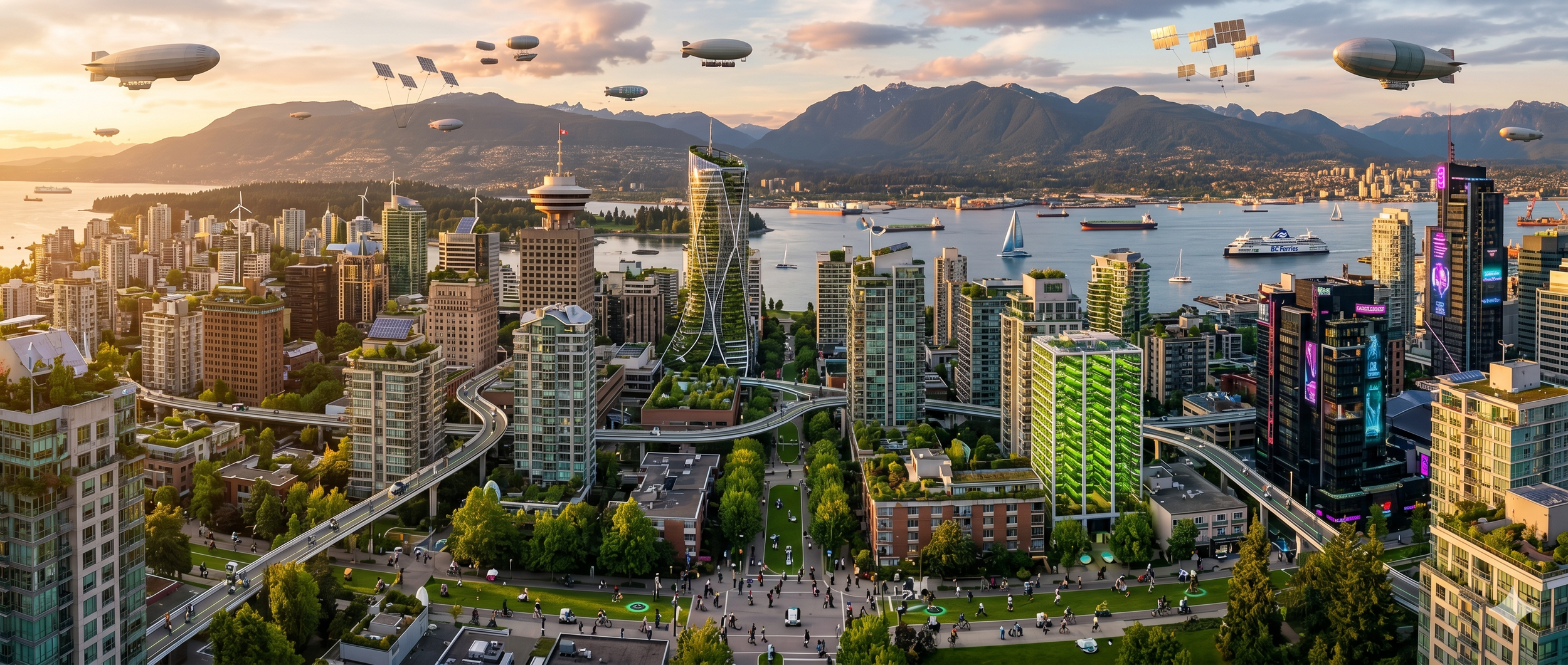
What’s the first thing you notice? Maybe the airships and solar arrays, drifting across the sky. In a world where people aren’t in a hurry to get back to their jobs, airships would be a viable and sustainable way to travel. And in a world that values human connection and wellbeing, sustainable travel will by prioritized. Meanwhile, capturing ever more of the sun’s energy and deflecting some of it back into space will likely form a significant part of a hybrid energy and climate strategy.
Naturally, my optimistic vision doesn’t feature things like war, famine or poverty. But the absence of those things isn’t necessarily obvious. I wanted to convey, at a glance, that the world I’m proposing is fundamentally different from the world of today. One of the most wasteful things humans do today is to drive individual people and things around in inefficient cars and trucks. In a hoped-for future where we don’t require the majority of people to commute to meaningless jobs, where much of the work people do can be done from home or somewhere they can easily walk or bike to, where agriculture and manufacturing of only what is necessary is done cleanly and close to where it’s needed, cities would no longer be designed around cars and trucks. In a city designed instead around healthy and meaningful living, I foresee hordes of small electric delivery robots, doing last mile deliveries among pedestrians, cyclists and other people-powered or micro-mobility transportation.
It was from this world that the character of B0R15 emerged.
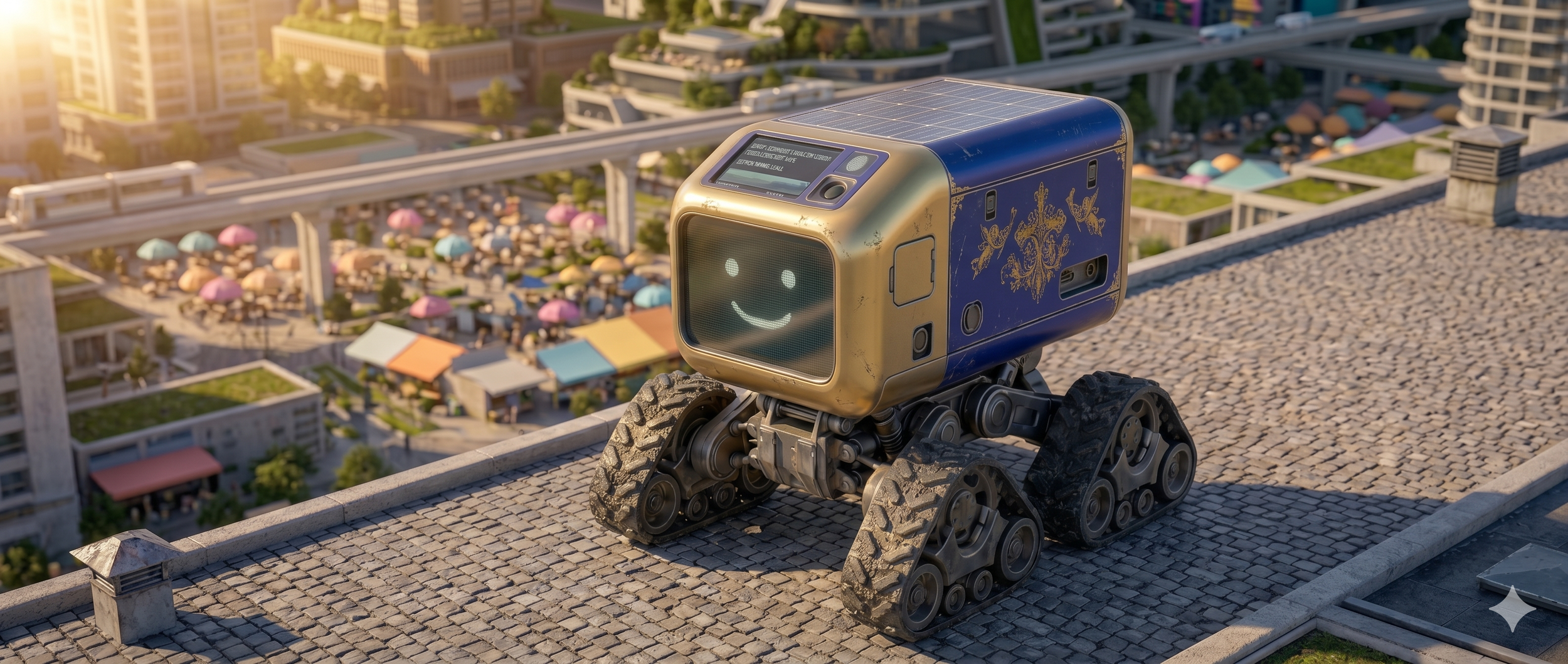
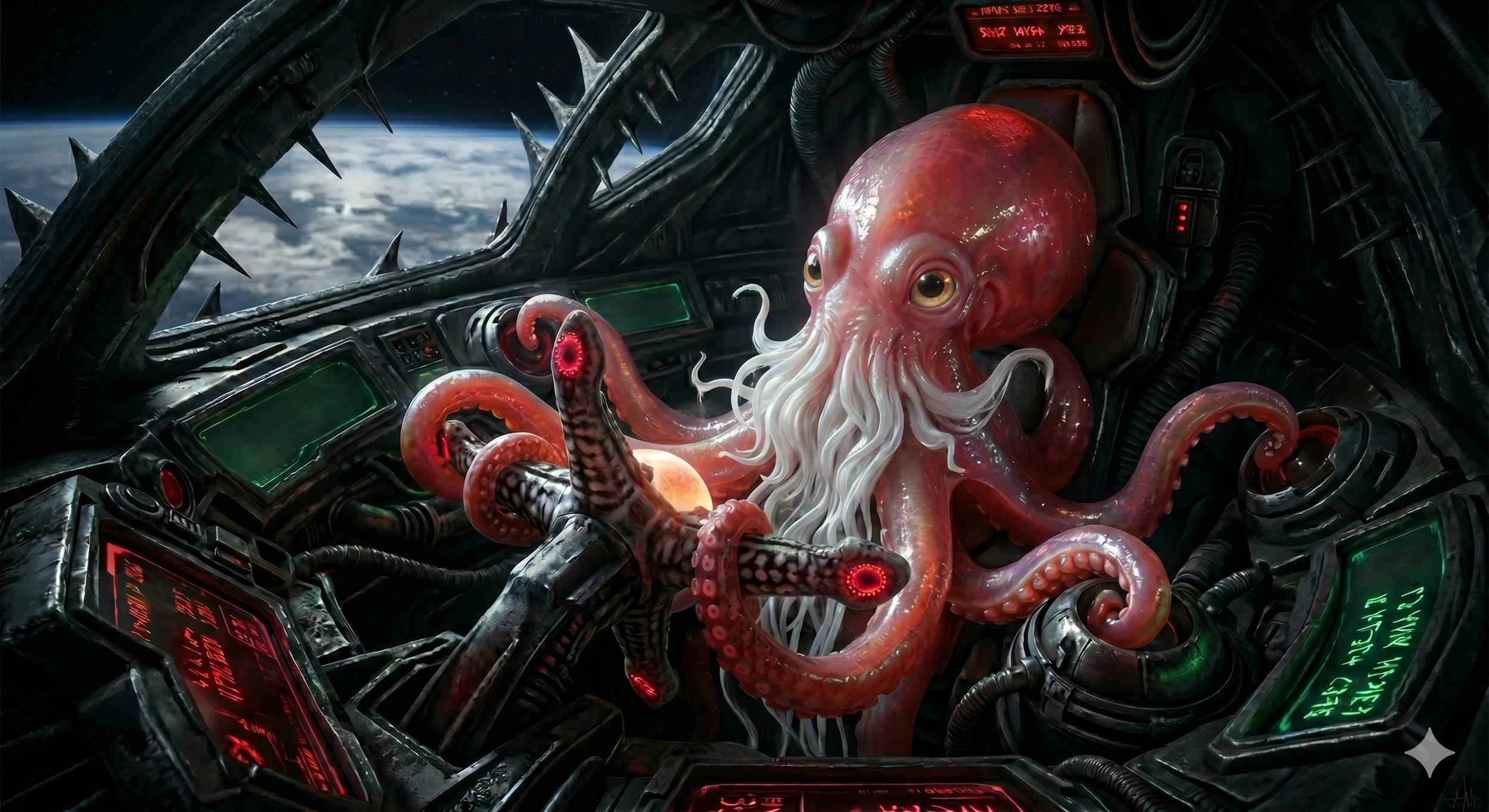
I suspect, in a future with less suffering, there would be less demand for the kind of afterlife promised by today’s organized religions. So B0R15 is a church bot that was up-cycled into a delivery bot once his church shut its doors. As a robot, B0R15 represents the downtrodden working class in my future world and so the promises of Christianity are still appealing to him. And, given that he was trained on the Bible, he interprets everything through that lens. When an alien spacecraft crashes into the North Shore mountains, the arc of light it carves across the sky reminds B0R15 of the story of Jesus and so he sets off to bring gifts to his savior. But instead of the son of God, B0R15 would meet a humble alien delivery pilot, Ceph, an octopus-like creature who happens to resemble Santa Claus. The fact that they both work in delivery roles would make it easier for them to figure out how to communicate with one another.
Given the multiple characters involved in delivery and the Christian angle, the name Deliver Us was an obvious choice for the title of this optimistic action-adventure comedy sci-fi Christmas movie.
At this point I had my main character, the central narrative of my film and I also had the core themes:
We all make up stories to explain what we don’t understand.
Genuine curiosity and the willingness to change our minds when we learn that our beliefs are wrong is one of the greatest virtues.
Next I set about developing other characters to allow the audience to consider these themes from different perspectives. A rival delivery bot, a robot love interest and a diverse cast of human characters who each misinterpret the shooting star in their own unique and equally wrong ways. It was important to me that everyone watching the film would be able to identify with at least one character and thereby imagine what kind of life they might lead in this hypothetical optimistic world. I dreamed up a pair of teenaged astronomers, a group of survivalists, the co-founders of a tech startup, the attendees at a wellness retreat and the team of volunteer taste testers at a gigantic robotic food prep factory to offer a diverse range of lenses through which to view the story.
Now this all sounds fun and uplifting, but any good story needs conflict. In the case of this story, conflict exists at two levels. First there’s the big philosophical question “can humanity transition from a civilization built on compulsory productivity to one built on voluntary purpose, without collapsing into self-indulgence?” And secondly there’s the more overt clashes between different groups of humans and robots with their conflicting misconceptions, racing to get to the crash site, to make first contact with this alien civilization.
To enter the competition I needed to provide a title, a logline (one or two sentences that distill the essence of the film), a synopsis, a creator statement, a 12 page treatment (scene-by-scene breakdown of the entire movie) and a 3 minute trailer or short film. And I had less than 3 months to do this all. On my iPhone. While backpacking around Europe.
I will share more detail of the actual production process that culminated in submitting a couple of days ahead of the deadline, in another post. Suffice it to say that hundreds of hours and thousands of dollars went into producing an entry that I felt good about. The trailer was not as polished as I would have liked, but I felt the written material was really strong. I imagined that any optimistic futurist watching the trailer, having first read the synopsis and creator statement, would be inspired to help get this film made.
Disappointingly, after submissions closed, the organizers admitted that they had no intention of reading everyone’s submissions. Instead they had a team of people watch random pairs of trailers and decide which one they preferred. In that way they narrowed 2,500 entries down to 50 (then, after an outcry, 65) finalists. Watching the finalists, it seemed that many should have been disqualified for being dystopian, pessimistic and/or violent, as the rules specifically banned those things. Instead of identifying and elevating hundreds of good ideas for optimistic visions of the future put forth by a diverse cohort of global creators, the competition elevated a few dozen flashy trailers made by people with big AI generation budgets and little compelling world-building—or even optimism.
But perhaps the most dystopian thing of all was that the finalists had to share the stage with Palmer Luckey, the guy made famous for “inventing” the Oculus Rift VR headset, who now builds autonomous weapons at Anduril, a company backed by Peter Thiel, among others. Luckey was also a recipient of an XPRIZE for Anduril’s wildfire mitigation technology. As someone who lives in wildfire territory and whose town barely survived one this summer, I’m not about to discourage investment or innovation in that field by anyone. But it was ironic that Luckey dedicated some of his time on stage trying to peace-wash autonomous weapons.
Future Visions, indeed.
Anyway, I still believe that Deliver Us has potential, both as an entertaining film and as a much-needed vision of a plausible post-scarcity future. Have a look at the teaser trailer below and if you’re interested in helping this film get made, please reach out. I am very serious about making it.